


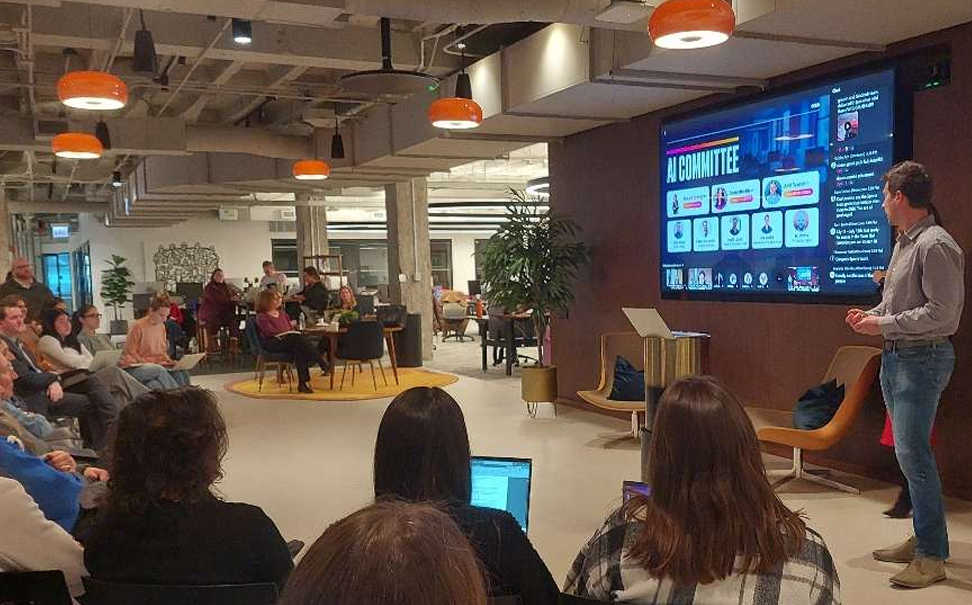
To excel at AI transformation, organizations need a clear narrative shaped by real employee experiences.
By Kris MacAuslan, EVP, Transformation & Workforce Engagement, Golin Corporate Affairs
My colleague Matt West recently wrote that adaptability now matters more than expertise. As AI rises, this reality grows every day. Yet, for many organizations, their AI story hasn’t yet included their people who are living through the change.
A recent HBR study shows that 90% of firms are now appointing chief data and/or AI officers; yet 93% of organizations say human issues like culture and change management are the biggest obstacles to adoption, the highest-ever percentage in the survey.
The technology investment is real, but the people strategy often isn’t.
The unlock to AI adoption lives on the human side. Corporate reputation in the AI era is built on real alignment between what’s said externally and what employees actually experience internally. And this gap is where most organizations are losing ground.
Help Employees See Themselves in the Future
It starts with one simple truth: AI business performance depends on employee experience. The power of AI goes beyond productivity gains to reimagining work itself. That’s AI’s strongest employee value proposition.
But when the AI narrative focuses on business performance and skims over the human experience, employee confidence lags, trust is low, and adoption stays uneven.
Helping a powerful workforce adapt takes more than platitudes about reskilling. It requires an environment that celebrates progress and experimentation, supported by an authentic AI narrative built on real experiences. A story that’s specific enough to be credible, human enough to be trusted, and honest and adaptable enough to handle hard questions.
It also requires senior leaders to model curiosity more than confidence. Momentum comes when leaders at the top can name the tools, the workflows, and real results people feel in their own experience. Leaders can also earn bonus points for credibility when they are honest about their own journey through ambiguity to adaptability.
When people are included in the design, they’re more likely to engage. The story becomes theirs, too.
Lessons from Golin’s Journey
When we set out to become the world’s first fully AI-integrated agency, we studied our employee experiences. We listened first and then adapted to achieve 93% AI adoption in nine months.
It may sound easy because great communication is our business, but the human truths inside Golin were identical to what we see with clients: uncertainty at the top, anxiety and skepticism in the middle, and champions hiding in plain sight.
We focused on helping our people see themselves differently, tapping into our founding ethos: stay curious to stay relevant. Not a mandate. A mindset. Before a single tool was deployed, we invited people to shape what it means to be AI-integrated, long before clients expected it of us.
We didn’t just train our people; we rebuilt how they think about their craft. In 2025, advanced users grew from 16% to 36% in less than a year. Employees created 1,700 custom AI assistants. We achieved our lowest turnover rate in company history. And 30% of our organic growth came from AI-enabled client solutions.
At its heart, our AI story is about the adaptability of our people.
What Three Months Can Do
We see this same dynamic with our clients.
We recently supported the communications team at a leading Fortune 500 company on their adoption journey. They had tools and leadership buy-in, but they needed a stronger narrative to connect their people to real opportunities and boost internal confidence to act on it.
Starting with a readiness assessment, we helped them understand where the team really was versus where leadership assumed they were. Then, we built a strategy tailored to their culture: prioritizing use cases, formalizing champions, developing toolkits for real workflows, specialized programs and workshops, and refining their AI story together.
In just three months, confidence and capability grew significantly. Regular tool use rose sharply. Most importantly, the team saw a 25-point increase in their understanding of what AI success looks like, backed by a double-digit confidence boost in their ability to build the skills to get there.
Your Story Starts Here
If you’re just starting to build the internal case, stuck in the middle of uneven adoption, or trying to close the gap between what your company says about AI and what employees actually experience, I’d love to hear from you.
I’m also glad to share early perspectives from our ongoing research into how AI narratives are shaping corporate reputation — including what’s working, what’s backfiring, and where the first-mover window is still open.
Find me on LinkedIn or reach out through Golin.
__________________________________________
Kris MacAuslan is EVP, Transformation & Workforce Engagement in Golin’s Corporate Affairs practice. She leads AI transformation consulting for Fortune 500 companies across financial services, healthcare, and consumer brands through Golin’s proprietary Lighthouse 360 methodology. Her approach positions communications functions as the strategic engine of organizational AI adoption.