


By Henry Wang, Associate
I almost didn’t know how to introduce myself when people asked what I do.
“I’m an associate at Golin and I work on GenAI visibility and measurement.” It’s a sentence that would have meant almost nothing not so long ago. Now, standing in a room full of some of the sharpest minds in communications and data analytics, it felt like exactly the right place to be.
That was the energy walking into my first AMEC AI Day conference, hosted by AMEC CEO Johna Burke, whose ability to hold a room, with equal parts wit and genuine intellectual curiosity, set the tone for a day that was both overwhelming and inspiring. I came in not entirely sure what to expect. I left with a full notebook, a handful of meaningful new connections, and a much clearer sense of where this industry is heading and what my role in it might look like.
Being early in your career in this moment is actually a good thing.
I want to sit with this for a second, because it’s something I’ve been thinking about since the conference ended.
There’s an easy narrative that says being junior in a fast-moving, AI-driven landscape is a disadvantage, that you’re behind, that you don’t have enough experience, that you’re still catching up while everyone else figures it out. AMEC AI Day made me feel the opposite.
The reality is that nobody has this fully figured out. Not the senior strategists, not the platform founders, not the agency heads. Everyone in that room, regardless of title, is learning as they go. And for someone early in their career, that’s not a limitation but an invitation.
Being junior in this space also means something specific. I don’t have years of pre-AI habits to unlearn. I’m not trying to retrofit a new way of thinking onto an old workflow. I’m building from scratch, at exactly the moment when the discipline itself is being built. What the summit made clear is that the knowledge I’m building right now, around prompt strategy, GenAI visibility, citation analysis, isn’t peripheral to the work. It’s becoming central to how the whole industry operates. Understanding that early, and being able to apply it for clients today, is something I’m starting to see as a real advantage rather than just a job description.
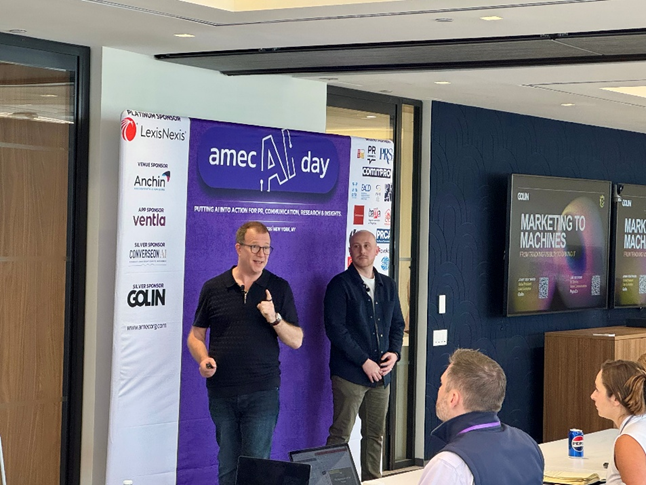
One moment brought it all together. Watching Golin’s own Jonny Bentwood, Global President of Data & Analytics, present alongside Louis DeCosmo of PepsiCo, I found myself thinking about how much of what they were discussing I had actually touched in my own work. Prompt development, GenAI citation analysis, owned content optimization. Their session revealed how PepsiCo discovered that up to 90% of their AI citations were coming from earned media, a finding that reshaped their entire approach to GenAI visibility and turned it into a CCO-tracked KPI.
Elise Masella, VP of Communications at PepsiCo, put it better than I could: “When Golin presented their Gen AI benchmarking findings across our 11 brands, it unlocked a level of strategic clarity around AI visibility that we simply didn’t have before and the roadmap they built from that work has been directly shaping how our brands show up in the models millions of consumers use every day. Seeing it presented at AMEC AI Day confirmed that PepsiCo is treating this as a serious discipline and that Golin has made us leaders in this space, not followers.”
As someone working on that discipline day to day, hearing those words meant a lot.
But what I’ll carry with me longest wasn’t a statistic. Jonny didn’t close with a grand framework. He closed with something much more useful: you’ll learn as you go, and while it can feel daunting, you just have to start. Every marginal gain counts. For someone who is still building confidence in this space, still learning on the job every single day, that landed differently than any framework or data point could.
The themes that kept coming back.
Sitting in session after session, I kept finding myself underlining the same ideas in different forms.
The first was about prompts. Rob Key of Converseon opened the day talking about context engineering, the idea that AI is only as accurate and useful as the context you give it. The prompts you build shape your data, your analysis, and your strategy. It sounds almost obvious when you say it out loud. But internalizing it, really understanding that the quality of your questions determines the quality of everything output, changes how you approach the work. It’s something I’ve experienced firsthand building prompt libraries for client campaigns, and it was validating to hear it framed so clearly by someone at the forefront of this space.
The panel with Siqi Jiang (Codeword) and Devon Bottomley (Prosek Partners) pushed this further, making the case that before you even think about measurement, you need to be clear on your objectives, your target persona, and the narrative you want to own. How you shape your prompts shapes your analysis. That’s not a technical detail but a strategic one.
The second recurring theme was visibility. Showing up in AI search isn’t the goal. How you show up is. Sessions from Onclusive, Hard Numbers, SimilarWeb, and Meltwater all approached this from different angles, but they converged on the same point: the brands winning right now are intentionally engineering their presence in AI-generated answers. Answer-shaped content, authoritative sources, community trust signals. A whole discipline that’s still being defined, which means the people doing this work right now, even at the associate level, are helping to write the rules.
The sessions that surprised me.
Beyond the GenAI visibility track, a few sessions caught me off guard in the best way.
Kaitlin Hileman, VP of Data Innovation at Ketchum, walked through synthetic audiences that use AI to simulate target personas and test strategies and messaging in a controlled environment. It’s the kind of capability that fundamentally changes how research gets done, and watching it in action made me realize how much the day-to-day of communications work is going to look different in just a few years.
Rob Bernstein, also from Ketchum, and Jennifer Sanchis of CARMA both addressed the workforce question directly: what skills actually matter in this new environment? Their answer was reassuring and a little surprising. Not just technical proficiency. Critical thinking. Ethical judgment. Contextual awareness. Strategic instinct. The skills that are hardest to automate are the ones that will matter most. As someone who sometimes wonders whether experience can be shortcut by tools, that was grounding to hear.
What I’d tell other juniors.
If you’re early in your career and trying to find your footing in this space, here’s what I took away from the day.
Start before you feel ready. That was the most consistent message across the entire conference, and it applies at every level, but especially at ours. You won’t have a perfect prompt set or a flawless measurement framework on day one. That’s fine. Build something, learn from it, and improve it. The people doing the best work in this space aren’t the ones who waited until they had it figured out.
Get clear on your objectives before you touch a tool. The panel made this point sharply: if you don’t know what you’re measuring or why, the data you collect is just noise. Start with the question, not the platform.
Lean into what AI can’t replace. The skills that felt almost old-fashioned in a room full of AI platforms, critical thinking, ethical judgment, knowing when something doesn’t feel right, are exactly what makes a junior practitioner valuable right now. Don’t underestimate them.
And talk to people. The conversations I had during the networking breaks were some of the most useful of the whole day. Everyone is figuring this out in real time, and most people are more willing to share what they don’t know than you’d expect. That’s the community this space is building, and it’s worth being part of.
What I’m bringing back.
I came into AMEC AI Day hoping to learn something. I didn’t expect to leave feeling more settled in the work I’m already doing, more confident that the questions I’m sitting with are the right ones, that the skills I’m building matter, and that being early in your career during a moment of genuine industry transformation is something to lean into, not shy away from.
I can see how lucky I am to be working in a space that’s moving this fast, where the thinking is still fresh, the tools are still new, and there’s genuine room to help shape what comes next. That’s something to get excited about.