


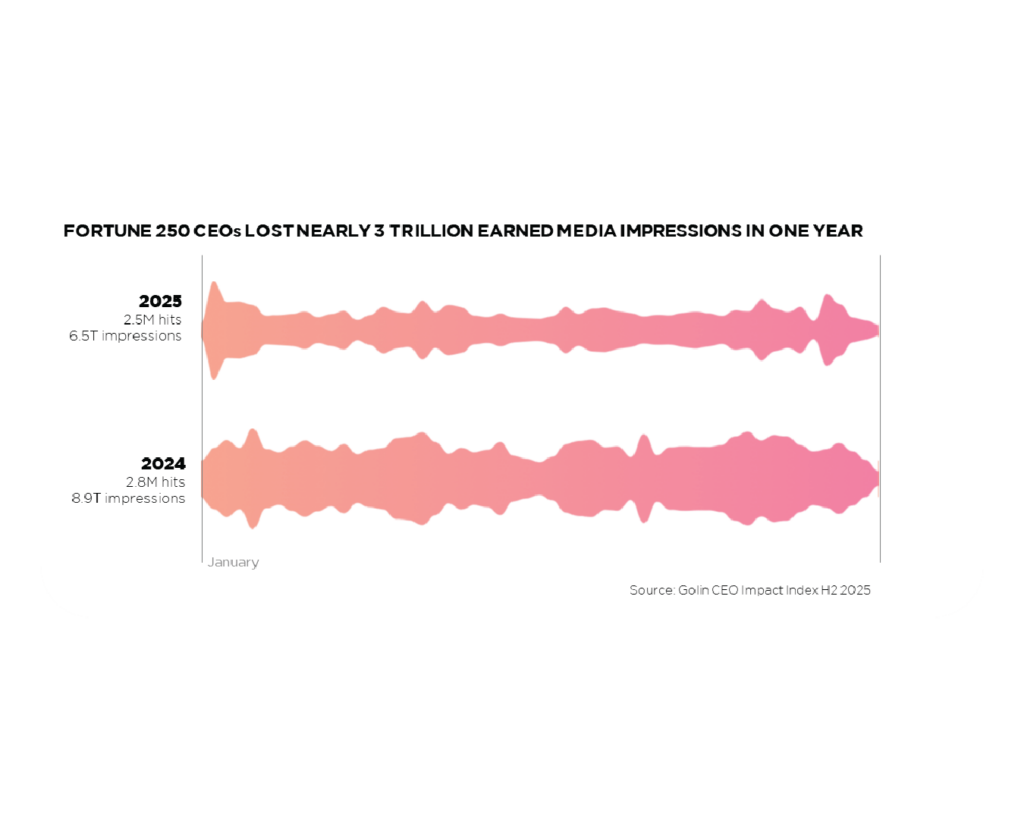
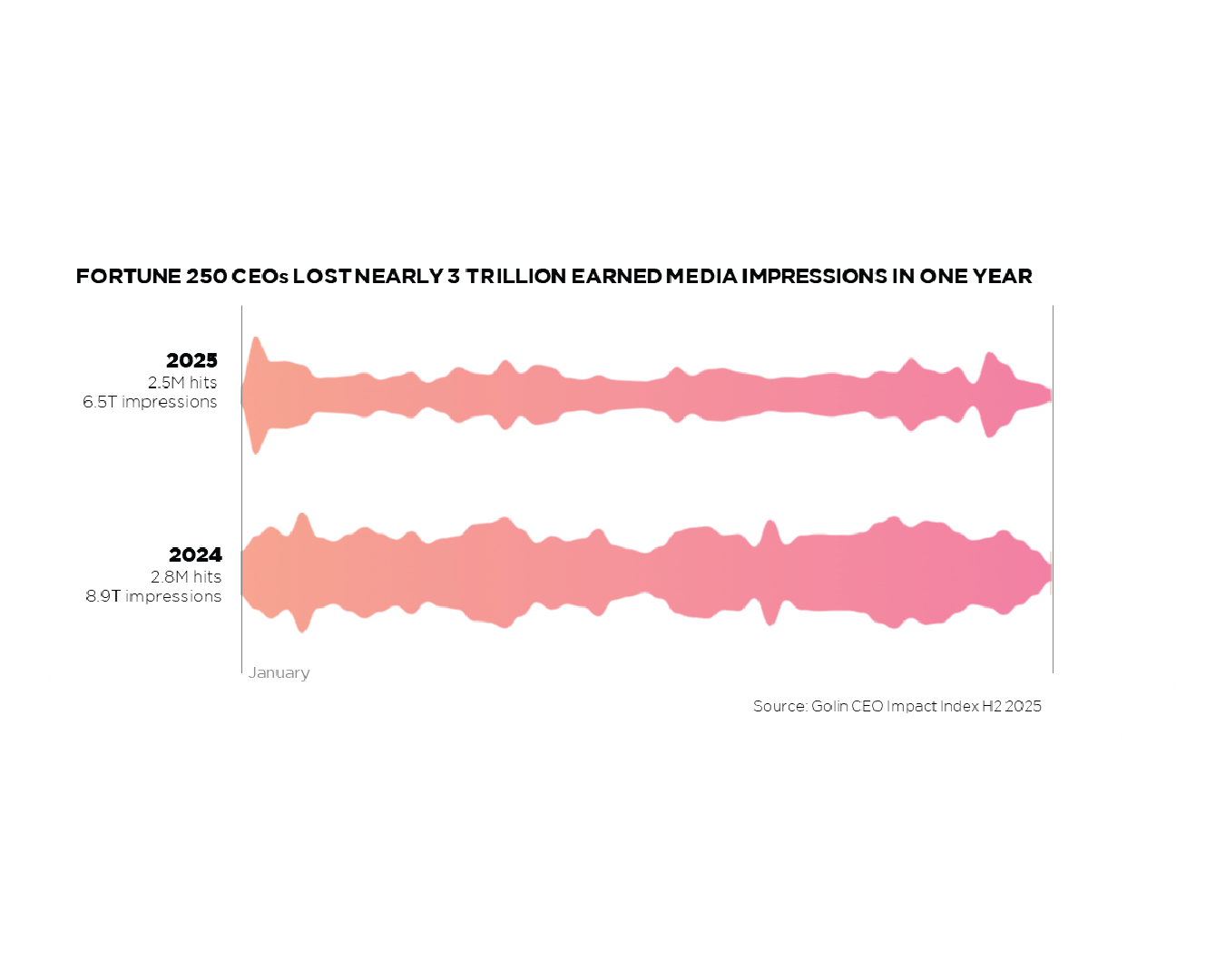
CHICAGO (April 14, 2026) – 2025 forced CEOs to recalibrate their communications for ‘the new normal’ according to a study from Golin, an Omnicom agency (NYSE: OMC). The CEO Impact Index, which measures and ranks the public engagement of the top 250 CEOs in the Fortune 500, showed a massive retreat of 3 trillion earned media impressions for CEOs in 2025. In this new era characterized by political and economic flux, sustained social polarization and accelerating AI transformation, those CEOs who maintained the strongest rankings in 2025 treated volatility not as a crisis to be weathered but as a new operating reality to be led through.
“Last year was one of the most disruptive years for CEO communications in recent memory,” said Sarah Vellozzi, U.S. Corporate Affairs Managing Director, Golin. “The leaders who performed best used surgical stakeholder engagement, not volume, to continue to produce the positive media coverage, third-party validation and stakeholder advocacy essential to growth. This is strategically important, because the CEO Impact Index shows that top communicator-CEOs deliver the strongest long-term shareholder returns for the companies they lead.”
The Business Case for CEO Communications
Since the launch of the Index in 2023, Golin has studied the business performance of the top-ranking CEO Impact Index CEOs versus their peers at the top of the Fortune 500 to determine if there is a correlation between CEO visibility and positive business performance. This latest report gives the strongest evidence yet that great CEO communicators create genuine business value; and superior communications is associated with sustained value creation over decades, not just short-term visibility gains.
The Top 10 and Top 25 Index-ranked CEOs have delivered consistently superior annual share price performance, averaging 2–3x the returns of Fortune Top 10 and Top 25 peers across all three years studied. On market value, the Top 10 and Top 25 Index cohorts consistently generate comparable or greater market capitalization despite being roughly one-third the revenue size of their Fortune counterparts — implying dramatically higher investor confidence premiums.
“The lessons for CEOs are clear: ‘the new normal’ rewards those who stay engaged with strategic precision, lead with business-grounded narratives, and maintain consistency between their words and actions. It punishes political positioning, inauthenticity, and generic claims without proof,” said Brian Besanceney, a senior advisor to Golin and former CCO at two Fortune 50 companies. “These findings are further proof that CEO communications have measurable real-world economic consequences.”
Other Findings from H2 2025
- The great retreat. The CEO Impact Index shows that the Fortune 250 CEOs collectively shed nearly 3 trillion earned media impressions in 2025 compared to 2024, with 90% of that loss coming from reduced engagement with traditional news outlets. This withdrawal from media, events and associations created a vacuum, allowing alternate narratives to grow. Strategic precision is the best path forward in ‘the new normal,’ prioritizing top-tier outlets, LinkedIn and quality interactions over vanity metrics.
- Politics rose to the top of the CEO agenda. President Trump was the #1 topic reported in association with Fortune 250 CEOs in 2025, appearing in 17.3% of earned coverage, surpassing even AI (9%). The winning model for CEOs in this environment was engagement without endorsement: framing policy-adjacent decisions in business language rather than political language.
- AI crossed the line from opportunity narrative to accountability test. 86% of Index CEOs now reference AI in their public communications (up from 81% a year ago), but AI adoption moved from talk of hiring slowdowns to explicit workforce reduction announcements framed as AI productivity wins – creating reputation risk. The lesson: leading with workforce reduction as the primary AI outcome generates significant sentiment liability, while anchoring AI narratives in product innovation, customer outcomes, or reskilling fares considerably better.
- The rewriting of the CEO social contract. Political pressure demanded CEOs retreat from social commitments while consumers, employees, and advocacy groups demanded consistency. 68% of Fortune 250 CEOs had social impact issues — DEI, climate, immigration, or political alignment — surface as a notable factor in their public engagement in 2025. The CII lesson: CEO silence around societal issues doesn’t build a shield, it reallocates risk.
To learn more about the latest CEO Impact Index, download the full report.